TORAH PORTION · PARASHAT VAYISHLACH · GENESIS 32:3–36:43 · HAFTARAH: OBADIAH
Beholding The Face of God At The Threshold
“So Jacob called the name of the place Peniel: ‘For I have seen God face to face, and my life is preserved.’”Genesis 32:30
This week’s Torah portion is Vayishlach (וַיִּשְׁלַח), meaning “and he sent.” Jacob sends messengers ahead to his brother Esau in Seir, the land of Edom. The Hebrew word for “messengers” is malachim, the same word translated as “angels” throughout the Scriptures. It appears just two verses after God’s angels meet Jacob on the road at the place he names Mahanaim (מַחֲנָיִם), “two camps,” where heaven’s angelic camp meets the camp of God’s covenant people on earth. Some ancient Jewish sages take the wording literally: Jacob sent angels. Whether he sent men or angels, he sent everything he had ahead, knowing he was walking into the greatest confrontation of his life.
This Torah portion marks a major transition. Twenty years earlier, Jacob fled from the land of promise back to Paddan Aram, to Mesopotamia, the land between the rivers, the region of Babylon from which his grandfather Abraham had been called out. He was running from his brother Esau, who had sworn to kill him. Genesis 27:41 says Esau hated Jacob because of the blessing, and he said in his heart, “The days of mourning for my father are at hand; then I will kill my brother Jacob.”
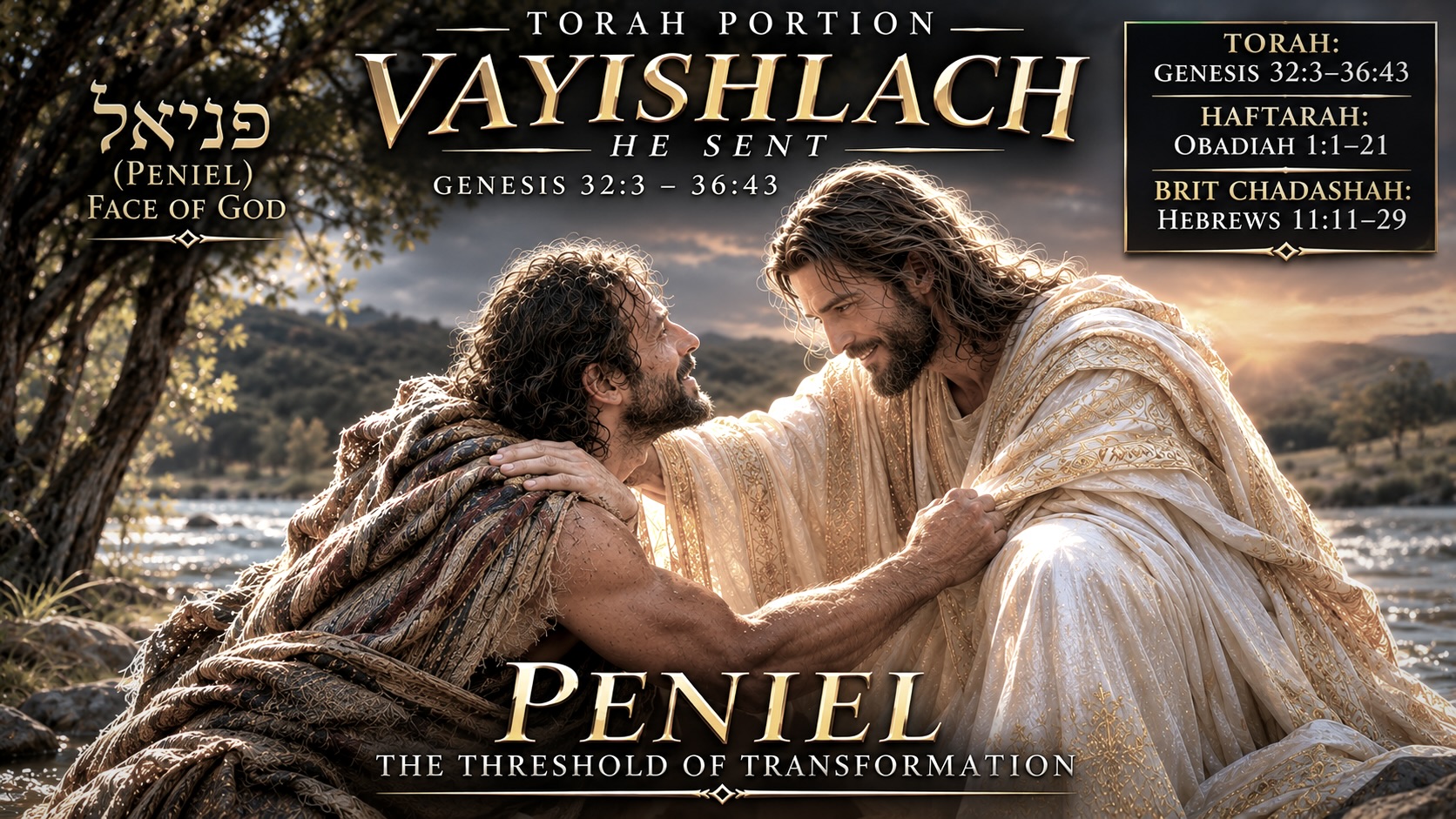
Twenty years later, Jacob must return and face his brother. The messengers bring word that Esau is coming to meet him with four hundred men. The idea of facing someone takes on deeper meaning when Jacob arrives at Peniel (פְּנִיאֵל), the “face of God.” This is the heart of the passage: we can face our enemies only when we first behold the face of our Creator, Almighty God.
SUNSET AND SUNRISE
Last week, in Vayetzei, we saw Jacob sent back to the roots of his family tree after an encounter with the Most High God. He saw angels ascending and descending as he laid his head on a rock, the very place where I believe his grandfather Abraham laid his father Isaac on the altar. Genesis 28:11 says he stayed there all night “because the sun had set.” Then, in Genesis 32:31, after Jacob wrestled with the Angel of Yahweh and walked away with a limp, it says, “the sun rose on him.” That’s not a coincidence. Sunset and sunrise are not merely poetic terms; they are prophetic. The Jewish sages recognized this as well. They said the sun rose that morning for Jacob’s sake to heal his limp, and they tied it to Malachi 4:2: “the Sun of Righteousness shall arise with healing in His wings.” The Sun of Righteousness is Messiah, and He rises over every Jacob who refuses to let go of Him in the night.
There are times and seasons when the sun sets on an old season, and we need an encounter with God to define the next. But the time between sunset and sunrise doesn’t always follow our timeline, because our Father, Yahweh, is eternal. He is the Ancient of Days.
Twenty years is nothing to the Eternal God, but to us, they represent a significant part of our lives. What the Lord accomplished in those years is what we’ve been exploring over the past six weeks: the Lord’s wilderness forge. The season of preparation is essential, shaping men and women to steward the realms of the kingdom and the depths of the covenant promise.
THE ETERNAL MIRROR:
BEHOLDING YOUR FACE IN THE FACE OF GOD
That’s where the Lord brought Jacob: face to face with himself and his uncle Laban. Jacob (Ya’akov) means “heel-grabber” or “supplanter,” a name rooted in akev, the heel he grasped at birth. Having deceived Esau, Jacob is now deceived in turn. He works seven years for Rachel, only to wake and find Leah in his tent. When Jacob confronts Laban, Laban replies, “It must not be done so in our country, to give the younger before the firstborn” (Genesis 29:26).
We can only imagine how angry and betrayed Jacob felt when he realized he was staring into the mirror of his own choices. The man who deceived his father in the dark to steal the firstborn’s blessing was himself deceived in the dark: he was given the firstborn daughter and reminded of the firstborn’s rights. He labored fourteen years for Leah and Rachel, then six more for his flocks. God has a way of letting us experience what we’ve done to others until we finally see ourselves clearly.
At times, what we call injustice in our lives may be a mirror held up by the eternal God, inviting us to examine our hearts and uncover the roots woven through our bloodline and family tree. Laban and Jacob shared patterns of trickery and injustice, and Rebekah, who devised Jacob’s deception in Isaac’s tent, was Laban’s sister. The pattern reaches even further back: Abraham told Pharaoh and Abimelech that Sarah was his sister (Genesis 12:13; 20:2), and Isaac repeated the same lie about Rebekah to the king of Gerar (Genesis 26:7). These are iniquitous roots of the enemy, seeds of deception sown generations before us, injustices carried through the family tree.
Until we confront injustice at its root, we cannot fully release authoritative words of justice. So, if we want to wield the sword of the Lord, we must first yield to it, allowing Him to remove every hindrance. These hindrances may not keep us from heaven, for salvation rests on the blood of the Lamb. But they can keep us from fulfilling our potential as sons of God, a calling that requires mature stewardship.
I have a deep concern for the apostolic, prophetic, and charismatic community. I believe most of the prophecies being released are true, but they will come to pass only as we yield to the sword of the Lord and mature as sons of God.
The covenant body of Christ stands at a prophetic threshold. Jacob faced a choice: remain in Babylon, serving his uncle Laban, or risk everything by confronting his past, meeting Esau, and facing what seemed certain death. He could trust the God of his fathers, who had met him at Bethel, or play it safe and remain enslaved in Babylon.
The global body of Christ may not recognize this threshold in human history, but we stand at it now. The Lord is saying, “Come out of her, my people, lest you share in her sins, and lest you receive of her plagues” (Revelation 18:4). It is time to cross over into who the God of Bethel declared us to be. Like Jacob, we must face and overcome the Esau within us. It is time to leave more than 1,700 years of Babylonian mixture and enter our covenant inheritance: the glory of God.
THE WHISPER OF THE SERPENT
In the garden, the serpent did not storm in and attack Adam and Eve; he whispered, “Has God indeed said?” (Genesis 3:1). He never asked them to stop believing in God. He simply invited them to mix God’s word with another voice. That same whisper reached the church in its early centuries, not as open rebellion but as a quiet invitation to blend the Kingdom with the culture around it.
The drift began quietly one generation after the apostles, as the gospel spread through the Roman Empire and its culture gradually seeped into the church. It was sealed at the Council of Nicaea in AD 325. Alongside the good fruit of the Nicene Creed came an infusion of Christianized paganism and the church’s divorce from its Hebraic, Jewish roots. An anti-Jewish spirit took hold in the church, and it can be seen plainly in Constantine’s own words.
Most Christians assume the church’s traditions came straight from Jesus and His apostles, but history tells a different story. In the fourth century, Emperor Constantine used Roman power to sever the church from its biblical, Jewish roots, specifically the Sabbath and Passover, and to rebuild it around a Greco-Roman system. After the Council of Nicaea in AD 325, he wrote to the churches ordering them to abandon the Hebrew Passover calendar, calling it “an unworthy thing that in the celebration of this most holy feast we should follow the practice of the Jews,” and commanding, “Let us then have nothing in common with the detestable Jewish crowd.”1
Constantine enforced this divorce through Roman law. Four years before Nicaea, on March 7, 321, he made Sunday rest the law of the empire, ordering that “all judges and city people and the craftsmen shall rest upon the venerable day of the sun,” the language of Rome’s sun worship rather than of Scripture.2 He branded Judaism a “nefarious sect,” made it a crime to convert to the Jewish faith, and decreed that any Jew who attacked a fellow Jew for converting to the church “shall be burned.”3 About forty years later, the Council of Laodicea (c. 363–364) turned imperial policy into church law, banning Sabbath rest: “Christians must not judaize by resting on the Sabbath, but must work on that day… But if any shall be found to be judaizers, let them be anathema from Christ.”4
This Roman overhaul overturned what Jesus had handed down to His disciples. In the generations before Constantine, early leaders like Polycarp, who was trained by the apostle John, kept Passover on the biblical date, the fourteenth of Nisan.5 Around AD 190, Polycrates of Ephesus testified that they kept “the day without tampering with it, neither adding, nor taking away,” following the apostles rather than Roman custom.6History is clear: Constantine and Laodicea did not preserve apostolic Christianity; they replaced it with a Romanized version of the faith.
Through those centuries, faithful saints and martyrs loved Him with a devotion far beyond my own, and I honor them. The question is not whether God had a people, but what the mixture has cost us.
Many of us earnestly desire revival, yet often what we long for is a revival of the version we inherited, the Greco-Roman form shaped by Christianized paganism. The new era that is continually prophesied is an era of reformation. True revival means reformation leading to the restoration of all things (Acts 3:19–21). We stand together at the greatest threshold of redemptive history. It is a threshold of true revival, crossing over from anointed orphans to manifested, mature sons, governing sons. None are exempt or superior; we ALL stand at this threshold together. No one is ahead, and no one is behind, because it hasn’t been time before; now we have come to the fullness-of-time moment.
Our decisions in the season ahead are crucial because they affect not only us but also our children, grandchildren, families, and the stewardship the Lord has entrusted to us. Let that move us to examine our hearts. We cannot play it safe, fear others’ opinions, or shrink from the cost. We must be our era’s spiritual pioneers: count the cost, take up our cross, and let the Lord possess us so the Father’s glory may be revealed in our generation.
I think everyone reading this can feel something in their spirit that they can’t quite define. You can’t see the way forward, but deep in your heart you know you’re at a threshold. There’s a stirring in your inner man crying out, “I’ve been made for more, and I can’t settle for going through the motions of traditional Christianity. I was made for the glory. I was made for a moment, and I will arise in this hour and fulfill the eternal purpose of my Father.” Do you hear the summons? It’s time to wrestle with the LORD face to face, allow HIM to strip away every cultural intrusion and tradition that doesn’t align with the divine blueprint, and return to the original faith Jesus handed down.
THE LORD OF JUSTICE AT THE FORD
But we must be careful here. When we discover what was taken from us, it is easy to pick up a dagger of accusation, against the generations who came before us or against brothers and sisters who still hold the traditions we are leaving behind. Jacob crossed the Jabbok with a limp, not with a sword to settle the score with Esau.
At the ford of the Jabbok, the low place of crossing on the way to the Jordan, the Lord was waiting for Jacob. Once again, He stands there in the Spirit, waiting for us. The Lord of Justice awaits with His sword drawn. Will we submit to His sword so that this generation may truly wield it? The Lord spoke these profound words to me, and they are worth repeating:
“How you steward your daggers of injustice will determine whether I can unsheathe a sword and a word of justice from your mouth in the days ahead. If you cannot love your enemies, pray for those who persecute you, bless them, and hope they receive not what they deserve but what I have given you, then you are nothing more than an anointed orphan, able to operate only at that level. But I am raising up sons who share My heart and My emotions, sons of justice. In them and through them, I will unsheathe the sword of My mouth in the fullness of time, striking down six thousand years of the enemy’s work of injustice throughout bloodlines and family trees.”
THE APOSTOLIC PATTERN PRODUCES APOSTOLIC AUTHORITY
Philippians 3:17–20“ Brethren, join in following my example, and note those who so walk, as you have us for a pattern. For many walk, of whom I have told you often, and now tell you even weeping, that they are the enemies of the cross of Christ: whose end is destruction, whose god is their belly, and whose glory is in their shame, who set their mind on earthly things. For our citizenship is in heaven, from which we also eagerly wait for the Savior, the Lord Jesus Christ.”
When Jacob sends word to Esau, his message begins, “I have dwelt with Laban and stayed there until now” (32:4). The Hebrew word is garti, meaning “I sojourned” or “I lived there as a stranger.” Jacob spent twenty years in the land of Babylon as a sojourner, never as a citizen. That is the question the Lord is asking His church: Have we been sojourning in Babylon, or have we settled down and taken out citizenship? Paul does not mince words. He declares that the mindset on earthly things makes us an enemy of the cross of Christ. Paul is addressing a people whose God was their stomach or their desires, the very antithesis of the apostolic pattern.
All the apostles of the first apostolic era truly lived as pattern sons. They replicated the blueprint of sonship modeled by the pattern Son, Yeshua HaMashiach. We see the apostle Paul and the apostle Peter teaching very similar principles about the release of the Kingdom, and we see the same pattern right here in this Torah portion, in Genesis 32:4: to be apostolic is to be a sojourner, an alien, and a stranger in this present age. I know that’s been abused, and it has kept us from infiltrating culture with the Kingdom. I truly understand and mostly agree with the seven-mountain mandate, which emphasizes that we need to invade culture. We desperately need to sit on school boards more than on church boards. We need to be Kingdom leaven in culture until we leaven the whole lump (Matthew 13:33), getting into every nook and cranny. But the key is this: the culture has no legal right in our souls.
The Lord spoke to me years ago about the kingdom mandate and said, “If you’re shaped by culture, you can’t shift culture.” The enemy’s greatest tool for rendering the people of God powerless is mixture. Mixture is why the fullness of the promised glory never comes, even though we prophesy it every year. It will not come until one generation fully divorces itself from the spirit of Babylon, leaves Babylon as Abraham and Jacob did, and crosses over.
Until then, we remain at the threshold of all the covenant promises of inheritance. The only way to truly shift the seven mountains of culture is to be sent from the mountain of the house of Yahweh, the mountain of the LORD established on the top of the mountains (Isaiah 2:2). To be a sojourner, an alien, and a stranger is to serve as an ambassador of another realm, of a different Kingdom (2 Corinthians 5:20). To be apostolic, to be an apostle, is to be like the Apostle and High Priest of our confession, Christ Jesus (Hebrews 3:1). His lifestyle wasn’t just for Him; it was the blueprint, the prototype of sonship, and the pattern for the tabernacle of His glory.
The only way to shift culture is to be wholly set apart from it and defined by the King of the Kingdom, living by every word that proceeds from His mouth (Matthew 4:4). Otherwise, we’ll settle for asking, “What’s in it for me?” and we risk carrying the same heart Ananias and Sapphira carried. They sold their land, laid only part of the proceeds at the apostles’ feet, and presented it as the whole (Acts 5:1–2). The problem wasn’t that they kept some of the money; Peter said the land and its proceeds were theirs to keep (Acts 5:4). The problem was that they wanted to appear apostolic, to seem fully committed when they weren’t.
But one generation will belong wholly to God. They will reflect the fullness of an unveiled face (2 Corinthians 3:18) and wield the sword that comes from the Lord’s mouth, striking down every antichrist spirit. They will not live for this world, for they “love not their lives even unto death” (Revelation 12:11).
1 Peter 2:9–11 “But you are a chosen generation, a royal priesthood, a holy nation, a people for his own possession, that you may proclaim the praises of Him who called you out of darkness into His marvelous light; who once were not a people but are now the people of God, who had not obtained mercy but now have obtained mercy. Beloved, I beg you as sojourners and pilgrims, abstain from fleshly lusts which war against the soul.”
The first apostolic generation understood what it meant to be chosen, a royal priesthood, a people belonging to the Lord. That understanding shaped a life that turned the world upside down (Acts 17:6). They lived as sojourners, aliens, and strangers, knowing that a seed must fall and die for new life to emerge (John 12:24).
Today, I ask: Have we fallen into the trap of embracing a culturally shaped Jesus rather than the true Jesus, Yeshua, the Messiah of Israel? Paul warned the church in Greece against “another Jesus,” “a different spirit,” and “a different gospel” (2 Corinthians 11:4). Could we, too, have absorbed a Greco-Roman image of Jesus, shaped more by Babylon’s influence than by the Hebrew Scriptures that revealed Him?
The call to restore the apostolic in Christianity, and the growing use of the title “Apostle” in charismatic circles, raises an important question: Do our lives truly reflect an apostolic way of life?
You may say, “Ed, you’re being critical and judgmental of the church.” I’m not judging the church; I’m examining my own life. For twenty years, I’ve wrestled with the Lord over why we keep hearing prophecies of glory without entering into it. Apostolic authority is released through apostolic living. Are we living as the early apostles did?
In 2 Corinthians 13:5, Paul urged the church in Greece to examine itself and test whether it was in the faith. The faith was more than doctrines or creeds, important as those are. It was a way of life: an apostolic life shaped by the example of Jesus Christ, our Apostle and High Priest.
This is the question I’ve wrestled with before the Lord: Am I apostolic in name only, or in the way I live? We are seeing a rapid rise in people being called apostles. Most mean well, and we all have an apostolic calling, but a calling is not the same as being an apostle. We must use the title carefully and discern wisely whom we call one.
I’m looking beyond AD 325 and the great Greco-Roman reset of seventeen hundred years ago. We must confront the blending of culture with the Kingdom, issue Babylon a decree of divorce, renew our covenant vows, and return fully to the original pattern revealed in the Son of God.
The apostles Paul and Peter, and their generation, lived with reckless abandon, embodying every word from the Father. They played it safe neither in life nor in faith, and they were not consumed by the distractions of their day. Their eyes were fixed on Him, captivated by the beauty of the One whose hands were pierced by nails.
A generation is coming that will hold Him at the threshold and wrestle with Him, and be struck, renamed, and forever changed. Like Jacob, they will walk with a limp.
TWO BROTHERS, TWO NATURES
Esau was Jacob’s twin, yet the two were opposites. Their conflict began before birth: Genesis 25 says they “struggled” (ratsats) within Rebekah. When she sought the Lord, He told her, “Two nations are in your womb… and the older shall serve the younger” (25:22–23). Esau emerged first, with Jacob gripping his heel.
Esau represents the fleshly man. Genesis 25 depicts him as a weary hunter returning from the field, while Jacob remained among the tents, cooking a lentil stew. Esau pleaded, “Please feed me with that same red stew, for I am weary.” The Hebrew is more vivid: “Let me gulp down some of that red, that red stuff.” For this reason, he was called Edom, meaning “red.” Edom is related to adom (“red”), adamah (“ground” or “earth”), and Adam. His name thus evokes the red earth associated with the first Adam.
Paul writes, “The first man was of the earth, made of dust; the second Man is the Lord from heaven” (1 Corinthians 15:47). Esau embodies the earthly man, governed by appetite and physical desire. He traded his birthright for a single meal, a bowl of lentil stew. Genesis 25:34 delivers the verdict plainly: “Thus Esau despised his birthright.”
The writer of Hebrews takes this and puts it in front of the New Testament church as a warning:
Hebrews 12:16–17 “Lest there be any fornicator or profane (bebēlos) person like Esau, who for one morsel of food sold his birthright. For you know that afterward, when he wanted to inherit the blessing, he was rejected, for he found no place for repentance, though he sought it diligently with tears.”
The Greek word for profane, bebēlos, comes from the idea of a threshold, a doorway trampled by everyone until there’s nothing holy left about it. Esau treated the holy as common, but notice he wanted the blessing; he just didn’t want the birthright. He wanted the blessings and the benefits without the responsibility of stewardship.
In Hebrew, the two words are almost the same: bekhorah (birthright) and berakhah (blessing). Esau makes the wordplay himself in Genesis 27:36: “He took away my birthright (bekhorati), and now look, he has taken away my blessing (birkhati)!” You can’t separate them. The blessing flows out of the birthright, and that is exactly what our generation keeps trying to pull apart.
Hebrews 10:26–29 “For if we sin willfully after we have received the knowledge of the truth, there no longer remains a sacrifice for sins, but a certain fearful expectation of judgment, and fiery indignation which will devour the adversaries. Anyone who has rejected Moses’ law dies without mercy on the testimony of two or three witnesses. Of how much worse punishment, do you suppose, will he be thought worthy who has trampled the Son of God underfoot, counted the blood of the covenant by which he was sanctified a common thing, and insulted the Spirit of grace?”
The language of Hebrews 12:16 is deliberate. As we read two chapters earlier, Hebrews uses the same image to warn against treating the blood of the eternal Son, the Lamb of God, with contempt: trampling (katapateō) the Son of God underfoot and counting the covenant blood as common (koinos). This is threshold language. Yet much of the church does not understand the threshold covenant or what it means to cross the threshold of the blood. That is a subject for another time, but consider this: Passover was a threshold covenant. In Exodus 12:22, the blood was taken from the saph, a Hebrew word meaning both “basin” and “threshold,” and applied to the lintel and doorposts. The LORD said He would pass over the door (12:23).
The tradition of carrying a bride over the threshold comes from this image. To step on the threshold was to trample the blood underfoot, an act that could lead to death. Jesus hung between heaven and earth, at its threshold, and poured out His blood across it. By His blood, He opened the doorway between heaven and earth. The question is whether we live in a way worthy of every drop of that blood, or treat the blood of the eternal Son as a ticket to an easier life, prosperity, and blessings.
THE FIRSTBORN AND THE FATHER’S ESTATE
Jacob wrestled with Esau in the womb over the birthright and firstborn blessing. In the patriarchal era, and even in Jesus’ day, the firstborn managed the father’s estate and inherited the covenant promises and family lineage. He also received a double portion, described in Deuteronomy 21:17 as pi shnayim, literally “a mouth of two.” This inheritance equipped him to serve as the family’s kinsman-redeemer (go’el): protecting the bloodline, preserving the estate, and safeguarding what his father had built.
If a father had three sons, his estate was divided into four shares. The firstborn received two shares, or 50 percent; each brother received one, or 25 percent. Whatever the number of sons, the firstborn received twice as much as each brother. The purpose was not simply to make him doubly blessed, but to equip him to bless others by securing the estate, the family’s future, and the bloodline.
I emphasize this because charismatic circles often speak of the double portion as though it means being doubly blessed. That is partly true, but it also carries a responsibility: to serve as a kinsman-redeemer of the Father’s estate, not our own. We share in the Father’s inheritance, yet the firstborn remains a central principle in redemptive history, one whose significance the church has yet to fully grasp.
This passage also shows that a firstborn can forfeit his place. Near the end of this Torah portion, Genesis 35:22 recounts how Reuben, Jacob’s firstborn, defiled his father’s bed. First Chronicles 5:1–2 explains that Reuben lost his birthright, which passed to Joseph’s sons. Both firstborns in this portion, Esau and Reuben, surrendered the Father’s estate to satisfy immediate appetite, forfeiting what they were born to carry.
THE CHURCH OF THE FIRSTBORN
Colossians 1:18 reveals that Jesus is “the firstborn from the dead, that in all things He may have the preeminence.” He is the last Adam, a life-giving spirit (1 Corinthians 15:45), and Paul says the Father predestined us “to be conformed to the image of His Son, that He might be the firstborn among many brethren” (Romans 8:29). He is the prototype Son, the source of a movement that would come forth from Him, and the kinsman-redeemer of every bloodline and every family tree. Understanding this is essential if we are going to fulfill our mandate as the generation that inherits all the covenant promises and becomes a glorious, radiant bride without spot or wrinkle, a body, a mature man, rising to the full stature of the image of Christ (Ephesians 4:13; 5:27).
Remember Paul’s theology unveiled in Romans 5, 6, and 7. God deals with all humanity through two Adams, the first Adam and the last Adam. The last Adam, Jesus Christ, overcame in the Garden of Gethsemane, defeating iniquity and severing it at the root, just as the first Adam failed in the Garden of Eden. Two gardens, two Adams, one story. The last Adam lived exclusively for the Father’s estate and for the brethren. He laid down His life so others could enter the Father’s estate and kingdom. Jesus didn’t do it all so we could be doubly blessed. He was the prototype, showing us the way to sonship.
Now consider where the writer of Hebrews takes this. Hebrews 12 is an entire ascension passage, written for an ascending generation. It opens with a great cloud of witnesses and a race set before us, “looking unto Jesus, the author and finisher of our faith” (12:1–2). It then speaks of the Father’s discipline and plainly says that if we are without His correction, “then you are illegitimate and not sons” (12:8). That is exactly what the Lord said to me about anointed orphans and sons of justice: an orphan wants the anointing without the Father’s hand, but a son yields to the hand that corrects him, because it is the same hand that will one day place the sword in his hand.
Then verse 13 says something that should make every one of us think of Jacob at the Jabbok: “make straight paths for your feet, so that what is lame may not be dislocated, but rather be healed.” The Greek word is ektrepō, meaning to be turned or wrenched out of joint. The same chapter that calls us up the mountain speaks of a limp being healed rather than dislocated, the very picture of a man who walked away from Peniel with his hip out of joint, the Sun of Righteousness rising over him, healing in His wings.
And then, right in the middle of the ascent, the writer stops and points at Esau:
Hebrews 12:14–16 “Pursue peace with all people, and holiness, without which no one will see the Lord: looking carefully lest anyone fall short of the grace of God; lest any root of bitterness springing up cause trouble, and by this many become defiled; lest there be any fornicator or profane person like Esau, who for one morsel of food sold his birthright.”
The roots of the family tree are exposed once more, and a root of bitterness springs up to defile many. Esau is called a fornicator. Genesis records that he took Hittite wives, daughters of the land, “and they were a grief of mind to Isaac and Rebekah” (Genesis 26:34–35). He embraced Canaanite culture, joining himself to the spirit of the age. We are warned not to follow his example. James puts it plainly:
James 4:4–5 “Adulterers and adulteresses! Do you not know that friendship with the world is enmity with God? Whoever therefore wants to be a friend of the world makes himself an enemy of God. Or do you think that the Scripture says in vain, ‘The Spirit who dwells in us yearns jealously’?”
“Without holiness no one will see the Lord.” The heart of this Torah portion is seeing His face. Holiness is not legalism; it is love. Holiness means being governed by every word that proceeds from the Father’s mouth rather than by your five physical senses. It means living as a SENT ONE from the mountain of the Lord (Zion) and walking on assignment in the earth as aliens and strangers, sojourners in time and space. Jesus said, “If you love Me, keep My commandments” (John 14:15). Esau was governed by the flesh and grew so weary that he became dull to what really mattered, his inheritance in the covenant promise; he couldn’t see beyond the bowl before him. Likewise, a generation that feeds the flesh more than its spirit will grow weak and keep embracing the spirit of the age, never truly beholding the face of God at Peniel.
Then the writer brings us to the top of the mountain:
Hebrews 12:18, 22–24 “For you have not come to the mountain that may be touched and that burned with fire, and to blackness and darkness and tempest… But you have come to Mount Zion and to the city of the living God, the heavenly Jerusalem, to an innumerable company of angels, to the general assembly and church of the firstborn who are registered in heaven, to God the Judge of all, to the spirits of just men made perfect, to Jesus the Mediator of the new covenant, and to the blood of sprinkling that speaks better things than that of Abel.”
Look at who is gathered on that mountain: an innumerable company of angels and the church of the firstborn. This is Mahanaim once more, the camp of heaven meeting the camp of God’s covenant people. Notice the phrase “church of the firstborn.” In Greek, it is ekklēsia prōtotokōn, with prōtotokōn in the plural: the assembly of firstborn ones. We are not merely the church that belongs to the Firstborn; in Him, we become a company of firstborn sons, entrusted with the double portion and the kinsman-redeemer calling for the Father’s estate. They are also “registered in heaven.” In the wilderness, the LORD told Moses, “Number all the firstborn males of the children of Israel… and take the number of their names” (Numbers 3:40), because the firstborn belonged to Him. Heaven, too, keeps a register of its firstborn. Even “general assembly” carries a festive force: panēgyris means a festal gathering, the joyful assembly of a feast.
I believe the writer is making a play on words. The ekklēsia are the called-out ones. We will explore this word more deeply when Jacob returns to Bethel. This passage tells us exactly what we have been called out of, and what we have been called to. Israel was called out of Egypt and brought to Mount Sinai, a mountain of fire and darkness, where the voice was so terrifying that even Moses said, “I am exceedingly afraid and trembling” (12:21). But we have been called to Mount Zion. In this hour, God is summoning a generation out of the seven hills of Babylon (Revelation 17:9) to the mountain of the house of the LORD, which “shall be established on the top of the mountains” (Isaiah 2:2). From that mountain, He sends forth a movement of the sons of Zion, releasing His voice: “For out of Zion shall go forth the law, and the word of the LORD from Jerusalem” (Isaiah 2:3).
Hebrews 12:25–29 “See that you do not refuse Him who speaks… whose voice then shook the earth; but now He has promised, saying, ‘Yet once more I shake not only the earth, but also heaven.’ Now this, ‘Yet once more,’ indicates the removal of those things that are being shaken, as of things that are made, that the things which cannot be shaken may remain. Therefore, since we are receiving a kingdom which cannot be shaken, let us have grace, by which we may serve God acceptably with reverence and godly fear. For our God is a consuming fire.”
This is the central focus of these ninety days. The writer draws on Haggai 2:6, where the Lord promises to shake the heavens, the earth, and all nations, then declares, “The glory of this latter temple shall be greater than the former” (Haggai 2:9). Joel sees the same shaking: “The LORD also will roar from Zion, and utter His voice from Jerusalem; the heavens and earth will shake” (Joel 3:16). This also echoes the mandate given in Jeremiah 1: the Lord places His words in the mouth of a young prophet “to root out and to pull down, to destroy and to throw down, to build and to plant” (Jeremiah 1:10), while watching over His word to perform it (1:12). Together, these passages paint a prophetic picture of the church operating from Zion, releasing the Lord’s voice and shaking everything that can be shaken until only His unshakable kingdom and latter glory remain: a covenant body, a glorious, radiant bride without spot or wrinkle. He is a consuming fire. As Moses declared, “For the LORD your God is a consuming fire, a jealous God” (Deuteronomy 4:24). His name is El Kanna (אֵל קַנָּא), the jealous God, and He is jealous for a bride He will not share with Babylon.
What does it look like, in practical terms, to belong to the church of the firstborn? It means no longer asking, “What’s in it for me?” but asking, “What does the Father’s estate, His kingdom, need from me: in my marriage, in the lives of my children and grandchildren, on my street, in my city, and across my nation?”
The double portion in my hands is not mine to hoard. It has been entrusted to me so the Father’s eternal purpose may be revealed through redemptive history. I steward the promises entrusted to my bloodline rather than selling them for a bowl of stew, as Esau and Reuben did. I can serve on the school board without allowing culture to claim the throne of my soul. And I live my whole life from Zion, where His face is seen and His voice is heard. So when everything around me is shaken, I remain part of the kingdom that cannot be shaken.
Obadiah closes this portion on that same mountain, with deliverers ascending Mount Zion. If we do not radically pursue sonship, we may want the inheritance without accepting the responsibility of stewarding the Father’s kingdom. In that, we are no different from the prodigal son, who said, “Father, give me the portion of goods that falls to me” (Luke 15:12): give me my inheritance now!
This is how individuals and bloodlines end up in life’s pigpens: they lose sight of redemption’s bigger picture and the very reason we have breath and walk the earth. Now, in this fullness-of-time moment, the Lord has brought us to the threshold of the spiritual Jordan River. We must wrestle with the Lord, look into the eternal mirror of His face, and overcome the Esau that resides in our flesh.
A BOWL OF STEW
Each of us has an Esau within us, ready to trade our birthright for instant gratification. We trade it for a bowl of TV stew or Facebook stew, spending countless hours watching baseball, football, and other sports. We are a generation driven by entertainment and comfort. None of these things is inherently bad or wrong to enjoy. The problem is the overload: the constant stream of media, entertainment, and comfort.
The Lord is not calling us to stop watching football or baseball, give up our hobbies, or never go golfing. That is not the point. The point is that these things have become a veil, obscuring our understanding of our true covenant inheritance: the glory of God. We settle for a bowl of lentils instead. None of us would say we would make that trade, yet we make it every day, and the way we’ve practiced Christianity has taught us to do so.
We’ve been sold a version of Christianity that, without meaning to, stands opposed to the way Christ calls us to live. It is subtle: it still seeks God’s glory, yet also craves its own bowl of stew, the stew of football, baseball, Facebook, Disney World, and every comfort our age has to offer.
You were made for more than spending forty years working, retiring, and hoping you have enough money to enjoy your final twenty years on your own terms. Life is a vapor; it appears briefly and then vanishes (James 4:14). You were made to be an eternal gateway, releasing eternity into time and space, and to manifest the covenant promises of God’s glory within your sphere of stewardship.
As I said earlier, for the past seventeen hundred years, the church has been shaped by culture, and as a result, it has lacked the authority to transform it. It is sobering that after Rome destroyed the temple, Jewish sages began calling Rome Edom. In their view, Esau’s house had moved to the seven hills. Within a few centuries, the church of Jesus Christ had made its home in Rome, governed by Roman structures, following Roman calendars, and shaped by Roman culture. We have been eating at Esau’s table for a long time.
Yet signs of reformation and revival are slowly restoring us to the divine blueprint: the body of Christ becoming a covenant body, the church, the glorious bride, the mature man growing into the full stature of Christ. One generation, with the image of God fully restored. Sons and daughters of dominion, of the kingdom come and God’s will done, releasing heaven on earth with every step. Stewards of the Lord’s living voice, whose words become judicial decrees from the Lord’s council and court.
We have been brought to the threshold, and we don’t even know it. We stand at the threshold of the covenant promises, yet we are still in Babylon.
MAHANAIM, THE TWO CAMPS
Genesis 32 opens with this account: “So Jacob went on his way, and the angels of God met him. When Jacob saw them, he said, ‘This is God’s camp.’ And he called the name of that place Mahanaim” (32:1–2). Mahanaim (מַחֲנָיִם) means “two camps”: heaven’s angelic host meeting the camp of God’s covenant people on earth. Twenty years earlier at Bethel, Jacob saw angels at the foot of a ladder. Now, on his journey home, they come to meet him.
Here, for the first time, we hear Jacob truly pray. Listen to the words of the supplanter: “I am not worthy of the least of all the mercies and of all the truth which You have shown Your servant; for I crossed over this Jordan with my staff, and now I have become two companies” (32:10). The Hebrew word for “I am not worthy” is katonti, literally, “I have become small.” The heel-grabber is becoming small. He left with nothing but a staff; he returns with two camps. For the first time, he recognizes that all he has comes from God’s mercy (chesed) and truth (emet). That is what twenty years in the forge produced.
Song of Solomon 6:13 speaks of “the dance of the two camps,” the dance of Mahanaim. Now it is time for the two camps to become one: heaven and earth moving together to enter and possess the promised land. And this is not merely the promised land of revival; it is the promised man, a body brought to the full stature of Christ’s image.
THE FORD AND THE THRESHOLD
Jacob came to the ford of the Jabbok, a river that flows westward into the Jordan. A ford (ma’avar) is a shallow place where people cross. The word comes from avar, “to cross over,” the same root as Ivri, or Hebrew. Abraham was called Abram the Hebrew (Genesis 14:13), the one who crossed over from the other side of the river, out of Babylon. To be Hebrew is to belong to a people who cross over. And crossing over requires descending to the river’s low place.
Throughout Scripture, the Jordan marks a transition. In Joshua 3, Israel stands at the threshold: “They set out from Acacia Grove, from Shittim, and came to the Jordan” (Joshua 3:1). What happened at Shittim? Numbers 25 tells us: Israel joined the feast of Baal of Peor. Seduced by the women of Moab and Midian, the people bowed down and ate at a pagan feast, abandoning their covering. Balaam could not curse them, but he could lead them into syncretism, a mixture that broke their covenant protection. Revelation 2:14 calls this the doctrine of Balaam. I have written a book about it that I have not yet released. After seventeen hundred years of syncretism, this is where the church stands. Whether in Joshua 3 or Genesis 32, we are at the threshold of crossing over.
As Phinehas rose up and struck down the mixture, Phinehases are rising today to confront syncretism and the lies of Balaam’s doctrine. Psalm 106:30 says, “Then Phinehas stood up and intervened, and the plague was stopped.” The Hebrew word for “intervened” is palal, also used for intercession in Jeremiah 7:16: to stand between as an arbitrator. Phinehas’s covenant zeal stopped the plague, and God gave him “My covenant of peace” and “the covenant of an everlasting priesthood” (Numbers 25:12–13). In 2017, the Lord said to me, “Phinehas’s intercession will be the salvation of your nation in the days to come.” The Phinehas-type intercessor who intervenes is rising at the threshold, and the Jacobs are setting their faces to seek Yahweh’s face.
LEFT ALONE
Genesis 32:22–24 says Jacob rose in the night, took his two wives, his two female servants, and his eleven sons, and sent them over the ford, and he sent over all that he had. “Then Jacob was left alone; and a Man wrestled with him until the breaking of day.” He knew he had to behold the face of God if he was going to behold the face of Esau and overcome. The Hebrew word is levado, by himself. His wives, his children, his flocks, and all his wealth were on the other side of the river, and Jacob stood there with nothing between him and God.
If one generation is going to overcome the Esau within, that Esau dimension that settles for less than the glory of God has to be dealt with. There must be a resolute spirit that comes forth and says, “I’d rather die here than live in captivity to Babylon anymore. I must behold the face of the Lord.” The Lord is lifting the eyes of a Jacob generation, “the generation of them that seek Him, that seek Thy face, O Jacob” (Psalm 24:6, KJV), a generation that will wrestle with Him until the breaking of the dawn of a new day.
WRESTLING UNTIL THE DAWN
The word for wrestled is vaye’avek (וַיֵּאָבֵק). Listen to the sounds: Jabbok (Yabbok), Jacob (Ya’akov), wrestled (ye’avek). The river, the man, and the wrestling all ring with the same sound, as if the Holy Spirit is saying this river was made for this man, and this man was made for this night. And the word is connected to avak, dust. They rolled in the dust of that riverbank all night long.
Jacob would not let go. He refused to let go. “Let Me go, for the day breaks.” “I will not let You go unless You bless me!” (32:26). Now think about this. Could Jacob really restrain the Lord, the Maker of heaven and earth? It’s almost comical, but it’s not, it's prophetic. When I used to wrestle with my three-year-old son, I’d let him pin me down. It’s the same imagery here: God lets us wrestle with Him, especially in threshold seasons, because what He wants is the grip.
The prophet Hosea tells us something Genesis doesn’t:
Hosea 12:3–4 “He took his brother by the heel in the womb, and in his strength he struggled with God. Yes, he struggled with the Angel and prevailed; he wept, and sought favor from Him. He found Him in Bethel, and there He spoke to us.”
Jacob wept. He was a man holding on to God with tears, pleading for a blessing he had once tried to steal. Twenty years earlier, he had taken a blessing by deception in his father’s tent. Now, at the Jabbok, he receives one through tears, holding on to the Lord in the dirt and refusing to let go. Look at the last phrase: “there He spoke to us.” Hosea says that what God spoke to Jacob He was speaking to us.
Some of what I’m saying in this article you’ll easily dismiss, saying I’m just a weird prophetic guy and that you don’t understand a word I’m saying. It’s because we don’t want to understand. We want revival our way. We want the revival that happened at Brownsville or Toronto, or the tent revivalists of the fifties like A.A. Allen, and we want Azusa Street. We want the revivals of Whitefield and Finney. We honor all of those revivals, but we won’t see a repeat of them. What is coming is greater: the reformation of all things, which will result in the restoration of all things (Acts 3:21). Great transitions require a people willing to wrestle with seventeen hundred years of tradition that appears to be about Christ but in many ways stands opposed to the way He lived.
WHAT IS YOUR NAME?
Then the Lord asked Jacob, “What is your name?” He answered, “Jacob” (32:27). This is a powerful prophetic moment, and one many people miss. The last time Jacob was asked who he was, he lied. Twenty years earlier, in his father’s tent, blind Isaac asked, “Who are you, my son?” Jacob replied, “I am Esau your firstborn” (Genesis 27:18–19). Now, before the Lord, Jacob tells the truth: “I am Jacob,” the heel-grabber, the deceiver, the supplanter. When he finally faces who he is in the Lord’s presence, a divine exchange takes place.
The Lord touched Jacob’s hip. Genesis 32:25 says He touched the socket of his hip (kaf yerekh), putting it out of joint. I often describe it as a punch to the bone marrow: the hip is where doctors draw marrow, where the body makes blood. God gave Jacob a holy infusion, a supernatural blood transfusion, and a new name. To this day, the children of Israel do not eat the sinew of the hip (gid hanasheh) because of what happened that night (32:32). God marked their table with the memory of Jacob’s limp. You can recognize a son of Peniel because he never walks the same way again.
Translators render the new name as “for you have struggled with God and with men, and have prevailed.” The King James Version says, “for as a prince hast thou power with God and with men, and hast prevailed.” Yisra’el (יִשְׂרָאֵל) is built from sar, meaning prince, one who rules in power or dominion, and El, meaning God. The Hebrew letter yod (י), the first letter of Yahweh’s name, is attached at the front. Yod pictures a hand; Israel, then, speaks of the hand of God’s dominion.
Jacob asked, “Tell me Your name, I pray,” but the Lord replied, “Why is it that you ask about My name?” and blessed him there (32:29). Jacob asked for God’s name; the Lord answered by giving Jacob a new one. Later, in Exodus 4:22, the Lord declares, “Israel is My son, My firstborn” (beni bekhori). The firstborn appears again. The birthright Jacob grasped for in the womb, God bestowed at the Jabbok with a new name. Israel is more than a nation: it is a covenant body, a governmental son, a firstborn kinsman-redeemer for the nations.
PENIEL, FACE TO FACE
“So Jacob called the name of the place Peniel: ‘For I have seen God face to face (panim el panim), and my life is preserved’” (32:30). A few verses earlier, we see how he planned to approach Esau. Sending gifts ahead, Jacob said, “I will appease him with the present that goes before me, and afterward I will see his face; perhaps he will accept me” (32:20). In Hebrew, the word for “face” (panim) appears four times: “I will cover his face with the gift that goes before my face; afterward I will see his face; perhaps he will lift up my face.” The word translated “appease,” kaphar, also means “atone” or “cover.” Jacob hoped to cover his enemy’s face with gifts, still relying on his own strategy.
That night, God showed Jacob a different face. The next morning, Jacob limped toward Esau and bowed seven times. Esau ran to meet him, embraced him, kissed him, and they wept (33:3–4). Jacob then said, “I have seen your face as though I had seen the face of God” (33:10). This is the heart of the Torah portion: Jacob could face Esau because he had first faced God. An enemy’s face loses its terror when we have seen the face of the Lord. To face our enemies, we must behold the face of our Creator, Almighty God.
Notice, too, what Jacob did not do. When Esau offered, “Let us take our journey; let us go, and I will go before you” (33:12), Jacob politely declined. He would travel slowly, at the pace of the children and flocks, and did not follow Esau to Seir. Jacob made peace with his brother, but after Peniel, he would not move his household to Seir or live under Esau’s covering.
PUT AWAY THE FOREIGN GODS
This is where the passage becomes uncomfortable, and where we must not look away. Jacob crosses the Jordan, arrives at Shechem, buys land, and settles there. Genesis 33:18 says he came “safely” to Shechem; the Hebrew word, shalem, means whole or complete. He has a new name, has reconciled with Esau, and builds an altar called El Elohe Yisrael, “God, the God of Israel” (33:20). It seems as though everything is complete.
But Shechem was not Bethel. At Bethel, Jacob had vowed that if God brought him back, the stone would become God’s house (28:20–22). In Haran, God had reminded him, “I am the God of Bethel” (31:13). Yet Jacob stopped short. And in the very next chapter, Genesis 34, his daughter Dinah goes out “to see the daughters of the land,” and the family is drawn into violation, compromise, deception, and bloodshed. When we stop short of Bethel and make ourselves at home in Canaan’s culture, our children can bear the cost.
Then, in Genesis 35:1, God says, “Arise, go up to Bethel and dwell there; and make an altar there to God, who appeared to you when you fled from the face of Esau your brother.” And consider what Jacob tells his household:
Genesis 35:2–3 “Put away the foreign gods that are among you, purify yourselves, and change your garments. Then let us arise and go up to Bethel; and I will make an altar there to God, who answered me in the day of my distress and has been with me in the way which I have gone.”
Foreign gods in Jacob’s house? Yes. In Genesis 31, Rachel stole her father’s household idols, the teraphim, and hid them in the camel’s saddle, sitting on them when Laban came searching (31:19, 34). Jacob’s own wife carried Babylon’s gods across the Jordan in the saddlebags. They wrestled with God at Peniel, received a new name, reconciled with Esau, built an altar, and named it after the God of Israel, yet Babylon’s gods were still riding along in their luggage.
That is the church at the threshold. We have had our encounters and our revivals. We have built altars bearing the right name. Yet Babylon’s gods remain in the saddlebags: the Roman calendar, pagan feasts baptized and renamed, and the Greco-Roman Jesus carried through seventeen hundred years of syncretism and hidden away so no one would find him. But no one can go up to Bethel, the house of God, while carrying the gods from the other side of the river. “So they gave Jacob all the foreign gods which were in their hands, and the earrings which were in their ears; and Jacob hid them under the terebinth tree which was by Shechem” (35:4). They buried Babylon beneath the oak and went up to the house of God.
Centuries later, Joshua made the same call in the same place. Standing at Shechem with the whole nation after they had crossed over, he declared, “Put away the gods which your fathers served on the other side of the River and in Egypt. Serve the LORD!” (Joshua 24:14). Then he set up a great stone “under the oak that was by the sanctuary of the LORD” (24:26), very likely the same oak where Jacob had buried the idols. The place was the same, and so was the summons: every generation that crosses over must come to Shechem and bury the gods from beyond the river. When Jacob’s household did, “the terror of God was upon the cities that were all around them” (35:5), and God appeared to Jacob again at Bethel, confirming his new name: “Your name shall not be called Jacob anymore, but Israel shall be your name” (35:10).
A COMPANY (Kahal) OF NATIONS
At Bethel, God gave the church another message it urgently needs to hear: “I am God Almighty. Be fruitful and multiply; a nation and a company of nations (kahal goyim) shall proceed from you, and kings shall come from your body” (35:11). Kahal means an assembly or congregation. Isaac had prayed the same over Jacob before sending him away: “that you may be an assembly of peoples” (kahal amim, 28:3). Jacob’s destiny was always to become a kahal.
In Matthew 16, Peter received the greatest revelation ever given to man. Jesus asked His disciples, “Who do men say that I, the Son of Man, am?” They answered, “Some say John the Baptist, some Elijah, and others Jeremiah or one of the prophets” (16:13–14). Then Jesus asked, “But who do you say that I am?” At the threshold of human history, the Lord is asking the church the same question: Who do you say that I am? Peter, often quick to speak, answered with a profound revelation: “You are the Christ, the Son of the living God” (16:16). You are the Mashiach. “Flesh and blood has not revealed this to you, but My Father who is in heaven. And on this rock I will build My church.”
My ekklesia, My kahal: My covenant people, joined to Me and to one another. That is the word’s true sense. It is not merely a Greek city-state assembly. It traces back to the Torah’s “day of the assembly” at Sinai (Deuteronomy 9:10; 18:16), where the Greek Old Testament (the Septuagint) used ekklesia for the Hebrew kahal. The church is a covenant people brought out of Egypt or Babylon, bound to God and to one another. The key lies in the word: ek-kaleō means “called out.” We may bear the name church without living out its full meaning.
That is why Revelation 18:4 declares, “Come out of her, my people, lest you share in her sins, and lest you receive of her plagues.” Isaiah 52:11 and 2 Corinthians 6:14–7:1 issue the same call: come out from among them and be separate. We stand at the threshold. The Lord calls us to leave Babylon and Egypt, bury the gods from beyond the river beneath the oak, ascend His holy mountain, and renew our covenant vows with Him. Wrestle with Him at the threshold, and He will give you a new name.
THE MYSTERY OF ISRAEL
Israel is still in play. The church did not replace Israel; it was grafted into Israel. The mystery of Israel in Romans 11:25 is understood only in the presence of Yahweh’s face, and this is exactly where the church is. The church stands at this threshold, where it must wrestle with the mystery of Israel, just as Paul warned the church at Rome, the very place where religious syncretism and corruption entered: “I do not desire, brethren, that you should be ignorant of this mystery, lest you should be wise in your own opinion.” You’re a wild olive shoot. You were grafted into their olive tree, drawing nourishment from their root. Paul could not be clearer: “Do not boast against the branches. But if you do boast, remember that you do not support the root, but the root supports you” (11:18). He warned that this ignorance, if defended, would grow into arrogance, and they themselves would be broken off, just as the Jewish branch was broken off (11:20–21).
Why was the Jewish branch broken off? Because they lacked revelation of the Messiah, defended their understanding, and became arrogant. Ignorance is not stupidity; even the most intelligent people can lack insight. Yet we can become so certain we are right, and that seventeen centuries of biblical interpretation must be correct, that we refuse to consider we might be wrong.
The same thing happened when Jesus was first revealed. The people were certain they knew who the Messiah was. They knew the Scriptures deeply; many could recite the first five books of the Bible and more. They had over a thousand years of teaching and tradition about the Messiah and God’s promises to Israel. But what they thought they knew blinded them to what they needed to see. Jesus stood before that generation, its teachers, and its God-given leaders, yet they refused to wrestle with the Lord at the threshold.
They were not entirely wrong: they had the right answer, but applied it incorrectly. We face the same danger. We have enough revelation to be born again, but not enough to release heaven on earth. May we not miss our moment. May we let God strike our hip and leave us walking differently forever.
Isaiah 49:1–8 is a must-read concerning the mystery of Israel. It speaks of the One hidden “in the shadow of His hand,” made “a polished shaft” and hidden in His quiver. Arrows speak of sons: “Like arrows in the hand of a warrior, so are the children of one’s youth. Happy is the man who has his quiver full of them” (Psalm 127:4–5). The arrow of the Lord is the Son of God. The word polished, barur, means purified, purged, an arrow of purity made ready to strike the heart of the King’s enemies, like Psalm 45:5, a messianic psalm. Then Isaiah 49:3 says, “You are My servant, O Israel, in whom I will be glorified,” and verse 6 says this Servant will “raise up the tribes of Jacob, and restore the preserved ones of Israel,” and be “a light to the Gentiles.” Who is the Israel that redeems Israel and the tribes of Jacob? It’s Yeshua the Messiah, the Israel of God that Paul speaks of in Galatians 6:16.
Listen: The Jewish people are the natural branch, entrusted with the covenants, the promises, adoption as sons, and the stewardship of the living scrolls (Romans 9:4; 3:2). God’s call on them is irrevocable (Romans 11:29). Jeremiah 31:31–37 declares that as long as the sun, moon, and stars remain in the sky, His promise to the natural branch of the olive tree stands.
That is why Romans 11 matters so deeply. We stand at a Romans 11, Genesis 32, Joshua 3 threshold. Will we cross over? Will we recognize Gentile arrogance where it hides? Is it possible that some of us carry a polished form of replacement theology even while we wave Israeli flags in our congregations?
Romans 11:11 gives us the mandate: salvation has come to the Gentiles to provoke Israel to jealousy. For two thousand years, from Abraham to Messiah, the Jewish people stewarded the covenant promises, the Scriptures, and the things of the kingdom. Many rejected Him, having become unteachable and entrenched in more than a thousand years of theology they believed pointed to Messiah, but which stood opposed to Him.
THE HAFTARAH: DELIVERERS ON MOUNT ZION
The Haftarah for this portion is Obadiah, a one-chapter book about the Lord’s displeasure with Edom, the nation descended from Esau. It’s a judgment on Esau and the nation that comes from his blood. The Bible is an incredible mosaic, a prophetic mosaic of patterns, types, and symbols that speak not only to our lives but to one generation.
Look at what the Lord says was Edom’s problem: “The pride of your heart has deceived you… though you set your nest among the stars, from there I will bring you down” (Obadiah 3–4). And look at Edom’s sin: “In the day that you stood on the other side, in the day that strangers carried captive his forces, when foreigners entered his gates and cast lots for Jerusalem, even you were as one of them” (v. 11). When was that? When Babylon came against Jerusalem in Jeremiah’s day. Psalm 137:7 remembers it: “Remember, O LORD, against the sons of Edom the day of Jerusalem, who said, ‘Raze it, raze it, to its very foundation!’” When Babylon tore down the house of God, Esau stood on the other side and cheered. Jacob is the one who crosses over; Esau is the one who stands on the other side, and the Esau spirit always ends up siding with Babylon.
The last chapter of our portion, Genesis 36, is Esau’s genealogy, and two things jump off the page. Amalek, the nation that attacked Israel from behind in the wilderness and that the Lord said He would war against from generation to generation (Exodus 17:16), was Esau’s grandson (Genesis 36:12). And Genesis 36:31 says, “Now these were the kings who reigned in the land of Edom before any king reigned over the children of Israel.” The flesh always grabs its throne first. Esau had kings while Jacob was still living in tents. But the end of the story belongs to Jacob.
Obadiah 18, 21 (NASB)“Then the house of Jacob will be a fire and the house of Joseph a flame; but the house of Esau will be as stubble… The deliverers will ascend Mount Zion to judge the mountain of Esau, and the kingdom will be the LORD’s.”
Deliverers, moshi’im, from the Hebrew root yasha, the same root as the name Yeshua: kinsman-redeemers standing on Mount Zion and judging the mountain of Esau, the flesh man, the spirit of this age, the spirit that sells the birthright for a bowl of stew. That is the firstborn company. That is the company of the overcomers.
Paul saw the same mountain. Right after unveiling the mystery of Israel in Romans 11:25, he writes, “And so all Israel will be saved, as it is written: ‘The Deliverer will come out of Zion, and He will turn away ungodliness from Jacob’” (Romans 11:26). Paul is quoting Isaiah 59:20, where the word is go’el, the Redeemer, the kinsman-redeemer, and only a few verses earlier the LORD “saw that there was no man, and wondered that there was no intercessor” (Isaiah 59:16). Yeshua alone is that Deliverer and that Redeemer; He is the One who comes out of Zion, and there is no other. But look at the singular and the plural. One Deliverer comes out of Zion in Isaiah and Romans, and Obadiah sees deliverers ascending Mount Zion. It is the same pattern we saw in Hebrews 12: the Firstborn, and the church of the firstborn ones.
I believe the body of Messiah, in union with His heart, becomes a partial fulfillment of what He alone fulfills completely, and Scripture itself shows us this. Isaiah 49:6 says the Servant will be “a light to the Gentiles,” and in Acts 13:47 Paul and Barnabas apply that very verse to themselves: “For so the Lord has commanded us: ‘I have set you as a light to the Gentiles, that you should be for salvation to the ends of the earth.’” And in the very next verse after the Redeemer comes to Zion, the LORD makes a covenant with His people: “My Spirit who is upon you, and My words which I have put in your mouth, shall not depart from your mouth, nor from the mouth of your descendants” (Isaiah 59:21). The Deliverer out of Zion raises up a company of deliverers on Zion, carrying His Spirit and His words in their mouths, standing in the gap where there was no intercessor, turning ungodliness away from Jacob, and provoking Israel to jealousy (Romans 11:11), until the kingdom is the LORD’s.
THE THIRD DAY
Jacob came from crossing over, and the sun was rising upon him. It’s the dawning of a new day, the third day. Just like Joshua: “within three days you will cross over this Jordan, to go in to possess the land” (Joshua 1:11), and “after three days the officers went through the camp” (3:2). There’s a third-day generation at the threshold. It’s time to wrestle in the place of Yahweh’s face.
I pray that over the next three years you would allow the Lord to reveal the Jacob in you and give you a new name. That you would allow the Lord to dislocate your hip and give you a holy blood transfusion and a new name, the hand of God’s dominion. Notice which church in Revelation was promised a new name. It was Pergamum, the church that tolerated the doctrine of Balaam (Revelation 2:14). “To him who overcomes I will give some of the hidden manna to eat. And I will give him a white stone, and on the stone a new name written which no one knows except him who receives it” (2:17). The church that held the mixture at the threshold is offered the new name, if it will overcome.
I believe this is what the Lord is saying to His body in this hour:
Behold, I stand at the threshold of the fullness of time, and I’m summoning My body in the earth to come, stand alone, and wrestle with Me; I’ll give you a new name, as I gave My servant Jacob, who clung to Me and would not let go. Just as I gave Jacob My name Israel, so too I will write My new name on you. I will give you a white stone that will grant you access to My counsel in the fullness of time. I offer to this generation the hidden manna, the revelation that I have hidden and held in reserve for one generation. I offer you a scepter, My scepter connected to My heart and emotion for humanity, which will enable you to rule with Me over the nations. I will truly cause you to sit with Me on My throne, as I also overcame and sat down with My Father on His throne. I will set you over nations with My words in your mouth, uprooting every iniquity’s plan and building and planting My original plan, design, and intent for those who have ears to hear and return to My blueprint.
Behold, I stand at the threshold, knocking on the door of every region and calling forth the overcomers; it’s time to cross over. Many claim the promises that I gave to the seven churches, but they were given to the overcomers, the ones who conquer the spirit of Esau, the spirit of this age, the spirit of instant gratification, the spirit of their own desires and their own five physical senses, and who arise and begin to govern from the Holy Spirit I placed within them. And to these I will say, Come up here, and I will show you the things which must take place. To them I will give the open door.
I am speaking to My global body. Who has ears to hear what I am saying? Many have itching ears and gather to themselves teachers, prophets, and apostles who will say what they want to hear. Just as it was in the days of Jeremiah, so it is in these days. Very few were willing to hear the words of My mouth in the mouth of My servant. They refused to hear My words through Jeremiah and preferred the words of prophets who said, “Peace, peace,” when there was no peace. They relied on the temple, the priesthood, the prophets, and the sacrificial system of their day instead of Me.
I offered My people reformation, restoration, and the covenant inheritance during the days of My servant Jeremiah, but they chose Babylon. The spirit of Babylon penetrated the shores of your nation 25 years ago and has never been defeated. The only thing that can overcome Babylon is covenant: My covenant body walking in true covenant fidelity with Me. This is a season to fully divorce Babylon and come out from her, My people. If you will hear My voice, turn and return to Me, and allow Me to remove everything that hinders true love, I will show you and reveal to you great and mighty things you never thought possible. Just as I brought Jacob to the place of My face and caused him to cross over, I will send you from the place of My unveiled face to establish places of My unveiled face in the earth: places of transformation. These places will be places of the full unveiling of My Person and Presence, places of salvation, healing, and generational deliverance, as I have revealed in Psalm 91. You must not play it safe in this hour; I call you forth to be who I created you to be, for I created you to be just like Me! You are the generation that comes to the full stature of My image and manifests Me without the mixture of generations. The future of your nation, your family, and your loved ones hangs in the balance between inheritance and captivity. I have a mantle and a sword waiting for you at the threshold. I will give you the ability to turn the battle at the gate of the sphere of influence that I have allotted to you. Know that the harvest can still be reaped, but the overcomers must arise in this moment.
NOTES
Eusebius, Life of Constantine, Book 3, Chapters 18–19 (AD 325).
Code of Justinian, Book 3, Title 12, Law 3 (March 7, AD 321).
Theodosian Code, Book 16, Title 8, Law 1 (AD 315/329).
Council of Laodicea, Canon 29 (c. AD 363–364).
Eusebius, Ecclesiastical History, Book 5, Chapter 24.
Polycrates of Ephesus, Letter to Victor of Rome (c. AD 190), quoted in Eusebius, Ecclesiastical History, 5.24.
All Scripture is NKJV unless otherwise noted.