JEREMIAH GENERATION - DAY 42 OF 90 - ALTARS OF THE LIVING VOICE
Revelation 16:7 And I heard the altar saying, “Yes, Lord God the Almighty, true and just are Your judgments!”
One of the most startling verses in the Book of Revelation appears in chapter 16, verse 7: the altar in heaven speaks. It doesn’t merely stand before the throne in silence while the Lamb is worshipped and the bowls of wrath are poured out — it cries out. It raises its voice in agreement with the LORD’s judicial decrees, proclaiming His judgments as true and just. In doing so, it becomes one of the most theologically loaded images in the entire Bible, a prophetic image that the contemporary church has largely walked past without pausing to understand what it actually means.
To understand the depth of this verse, you have to resist the urge to explain it away too quickly. Many commentators and teachers do just that — calling the altar’s voice a figure of speech, a poetic way to describe the martyrs’ cries — and then moving on.
That answer is not wrong, but it is incomplete, because the deeper question the text is pressing us to ask is not simply who speaks but why the altar is the place from which that voice comes, and what that reveals about the nature of the altar itself, the relationship between heaven and earth, and the kind of corporate witness the LORD is building in this generation as the ages come to their culmination.
TWO ALTARS, ONE TEMPLE
Revelation’s altar theology is not simple, and understanding it requires distinguishing between the two altars in the heavenly sanctuary throughout the book. The first is the altar of burnt offering — the bronze altar in the outer court — which appears in Revelation 6:9, where John sees the souls of the martyrs beneath it, crying out to the LORD: “How long, O Lord, holy and true, until You judge and avenge our blood on those who dwell on the earth?”
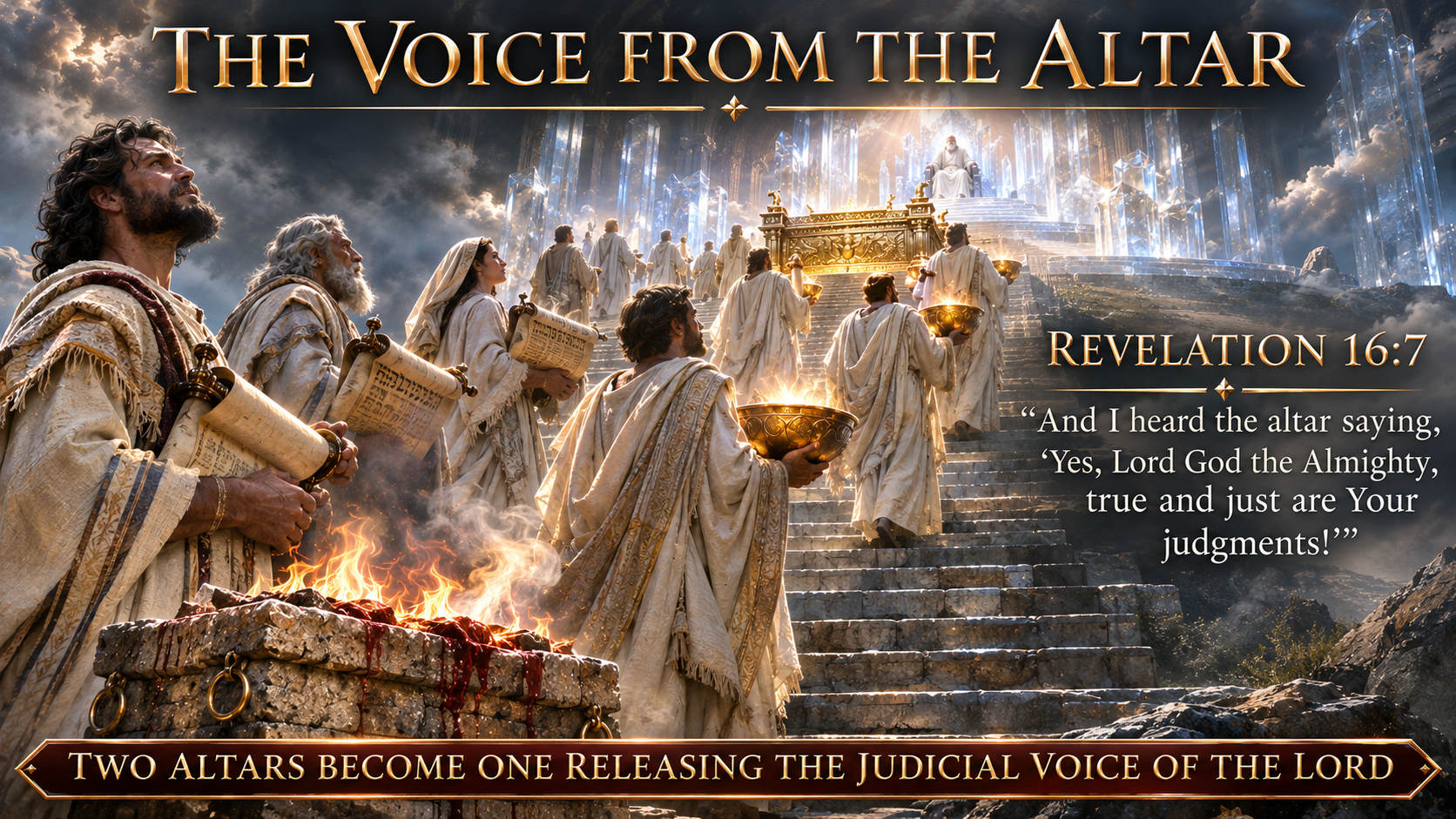
The connection to the Levitical altar is deliberate and precise: in the Torah, the blood of the purification offering was poured at the base of that altar (Leviticus 4:7), because the life is in the blood (Leviticus 17:11). So the martyrs — who gave everything, who poured out their lives as a sacrifice — are found at the base of that altar, their blood crying to the LORD from the ground, as Abel’s blood cried from the earth after Cain. They have not yet entered the full glory of heaven; they are waiting, robed in white as a promise, holding the pledge of what is coming, and their cry is judicial — not a cry for comfort, but a cry for the Most High God’s righteous verdict to be rendered over history.
The second altar is the golden altar of incense, which stands directly before the throne, and it appears in Revelation 8:3–5 in one of the most significant passages in the entire book:
Revelation 8:3 Then another angel, having a golden censer, came and stood at the altar. He was given much incense, that he should offer it with the prayers of all the saints upon the golden altar which was before the throne.4And the smoke of the incense, with the prayers of the saints, ascended before God from the angel’s hand.5Then the angel took the censer, filled it with fire from the altar, and threw it to the earth. And there were noises, thunderings, lightnings, and an earthquake.
The prayers of the saints — every prayer ever offered in covenant fidelity, every cry from every altar in every generation of the people of God — ascend from the golden altar before the throne. When that incense reaches its full measure, fire from that altar is cast to the earth, and the seven trumpets sound. The prayers of God’s covenant people are not merely devotional exercises; they are judicial instruments. They ascend to the heavenly altar, mingle with the fire of God, and are cast back to the earth as governmental decrees that release the purposes of the Most High into the specific situations and seasons He has ordained.
Then, in Revelation 9:13, something even more explicit occurs: a voice comes from the four horns of the golden altar before God, commanding the release of the four angels at the Euphrates — a voice that unleashes judgment upon the earth. In the Old Testament, the four horns of the altar were the place of covenant protection and covenant appeal (1 Kings 1:50–51; 2:28), but when the altar was genuinely consecrated, they were also the place from which the Voice of the LORD moved with governmental authority over the nations. Here, in Revelation 9, that voice from the horns of the altar issues a decree that will affect a third of mankind.
WHAT THE ANCIENT RABBIS UNDERSTOOD
The ancient rabbis, in their own way, understood that the earthly altar had its prototype in heaven. The Talmud (b. Hagigah 12b; b. Menahot 110a) records the tradition that the angel Michael serves as the High Priest before a heavenly altar, and that what is offered at the earthly altar corresponds to and connects with what is offered before the throne of the Almighty.
Heaven and earth are not disconnected systems operating independently of one another — they are designed to function in a kind of vertical alignment, so that what is genuinely offered at the earthly altar in covenantal fidelity and sacrifice becomes part of the ascending corporate witness before the throne of the Lamb.
The Church inherited this understanding and then gradually lost it, substituting a purely horizontal, therapeutic model of the altar—a place where individuals come to feel better, receive a word of encouragement, and get enough breakthrough to make it through the week—for understanding the altar as a place of vertical alignment with the heavenly reality, where the sacrifice of a covenant people ascends and the judicial Voice of the King descends in response.
I do not want to be misunderstood here: individual breakthrough at the altar is real and necessary, and I am not diminishing it—but I believe we have largely lost the understanding that the voice of the LORD, released through a genuinely corporate altar, is the very instrument through which the Kingdom advances on earth.
THE VOICE THAT GOVERNS
So when the altar speaks in Revelation 16:7, it isn’t merely poetic language. It is the culmination of the scarlet thread of covenant theology concerning Yahweh’s corporate witness, running from Genesis to the Revelation of Jesus Christ. The altar speaks with one voice, composed of three: the faithful believers under the altar, who gave everything and cry out for justice; the believers whose prayers have been rising from the golden altar before God’s throne; and the Voice of the LORD Himself, answering through the fire, because His people remained faithful to the covenant with Him.
It is a corporate voice, many people speaking as one, and that is exactly what the LORD is building when He calls His people to true apostolic prayer: not a room full of individuals each praying only for their own needs, but one family bound together in covenant whose unified, sacrificial cry before His throne becomes the voice through which His judicial decrees are released into the earth.
An important distinction must be made here, one that is easy to miss but theologically critical: the distinction between the mercy seat and the altar. Hebrews 12:22–24 tells us that we have come to Mount Zion, to the heavenly Jerusalem, to Jesus, the Mediator of the new covenant, and to the blood of sprinkling that speaks a better word than the blood of Abel. That blood, the blood of the Lamb, speaks from the mercy seat. It speaks of forgiveness, reconciliation, adoption, and eternal life. It speaks the better word over every sin, every failure, and every death. That is not the full application of the voice from the altar.
The voice from the altar is not about reaching heaven. Reaching heaven is fully covered by the blood of Jesus, which speaks from the mercy seat, as seen in Hebrews 12. The voice from the altar is about bringing heaven into the earth—and it takes us back to the starting point of these ninety days:
Jeremiah 1:9 Then the LORD put forth His hand and touched my mouth, and the LORD said to me: “Behold, I have put My words in your mouth.10Behold, I have this day set you over the nations and over the kingdoms, to root out and to pull down, to destroy and to throw down, to build and to plant.”
The voice of the LORD from the altar is the decree that governs nations, breaks the assignments of principalities, calls regions back to their covenant purpose, and advances the Most High’s redemptive plan through the generations. The LORD’s voice is released through an earthly covenant altar: a corporate covenant-keeping people genuinely aligned, in real sacrifice and real fidelity, with the heavenly altar before the throne.
The covenant-keeping God is looking for a covenant-keeping people. And that is where the Voice of the LORD is released from.
The Apostle John confirms this in a verse often misread: “And there are three that bear witness in the earth — the Spirit, the water, and the blood — and these three agree” (1 John 5:8). The Spirit, the water, and the blood bear witness — they testify — and in the context of Revelation’s altar theology, their testimony is not merely internal and devotional; it is judicial and governmental. The Spirit testifies. The water testifies. The blood of the Lamb testifies. And when the people of God live in that testimony, genuinely and corporately, in covenant fidelity, the altar of earth aligns with the altar of heaven, and the voice from that place carries the authority of the counsel of the Most High God.
THE NEW APOSTOLIC PRAYER MOVEMENT
This is the theological foundation for what I believe the LORD is building in this fullness-of-time moment. When I speak of a new apostolic prayer movement, I am not referring to better worship sets, more polished prayer conferences, or even greater individual devotional intensity — as valuable as those things may be. I am referring to a corporate covenant body in city after city and region after region that truly understands what it means to become an altar — and to come to an altar connected to the altar of heaven.
I say become an altar deliberately, because without being a walking altar, without being a living sacrifice in the most literal sense of Romans 12:1, there is no authority, even if we gather to create a corporate gathering we call an altar. Our level of consecration to the Father’s eternal purpose is the crucial variable in releasing His living voice in the earth.
That is what I mean by covenant fidelity, a term the LORD has deeply imprinted on my heart and through which I continually examine my own life, because walking in covenant faithfulness with Him is the linchpin for releasing His authoritative voice in the earth. It is so easy to drift from that reality.
I can use the language of covenant fidelity; the question is whether my life proclaims that I am living exclusively for the Father’s eternal purpose, secured through the blood of His Son. That is where authority is released from. Not from the vocabulary of consecration, but from its life.
And yet, as essential as individual covenant consecration is, it is never the destination, because it has always been about the corporate covenant body. During a consecrated time of seeking the LORD about the future of Gateway Hope Center, the Voice of the Lord thundered this to me:
“The individual Christ had to die for the corporate Christ to come forth in the earth.”
I say “thundered” because I felt struck by revelatory lightning; He was speaking directly to something in me—don’t let people depend on your anointing; don’t become the anointed one in their lives; model covenant fidelity and help them walk in the anointing the Father has specifically for them. And then He said:
“The last expression of the prayer movement must build an altar and climb upon it to transition into the new movement of My Voice in the earth. There must be a death of the old to truly fully enter the new; there will be no old in the new for what I am doing in the earth.”
I took that word seriously. I literally closed Gateway Hope Center (Gateway House of Prayer and Equipping Center), even though we could have continued. Our last service was on September 10, 2023. The very next month, the global prayer movement was jolted by IHOPKC’s downfall. The individual anointed prophetic church must become a regional corporate covenant body, not dependent on one or two anointed leaders, but a royal priesthood fully equipped, fully engaged, fully employed — understanding that Jesus said, “My Father’s house will be a house of prayer.”
IT’S TIME FOR THE CORPORATE CHRIST TO COME FORTH
None of us can reach the destination or release the authoritative voice of the LORD unless we allow that death-and-resurrection principle to take deep root — because the voice from the altar in Revelation 16:7 is not an individual voice but a corporate one. It was never individual, nor is it meant to be. There must be a regional expression of this that moves beyond any one person’s consecration, and building a corporate altar in a region will require a level of sacrifice that most are unwilling to make, because it is far easier to do it yourself. But that is not the way of the King of the Kingdom. That has never been the way the Father has operated on the earth through His people.
The mystery of the voice from the altar, the voice in Revelation 16:7 and the cry of the faithful believers beneath the altar in Revelation 6:9, is not, in the end, as difficult as it might first appear. When our altars, our hearts, remain completely faithful to the altar in heaven, all our voices merge into one, releasing that corporate voice from the altar. The voice of those who died for Christ and the voice of God’s devoted people offering their lives to Him in this present hour become one voice, united with His—and from that union comes a voice from the altar that the nations were always meant to hear.
The altar in heaven is not silent. It carries a voice that releases the King’s decrees into the earth. Throughout the Book of Revelation, that altar isn’t about keeping believers comfortable — it is about God releasing His judicial verdicts against the principalities, powers, and dark spirits that have set themselves against His redemptive covenant plan.
In Revelation 16:7, the altar speaks because every prayer prayed in covenant alignment, every life poured out as a sacrifice for the Kingdom, and every drop of blood shed in faithfulness to the LORD of Hosts have been accumulating before that altar. When it speaks, it does so with the full judicial weight of the counsel of the Most High — true and just are Your judgments.
That is what an aligned altar sounds like. That is the voice the earth is waiting to hear. And the LORD is looking for a people in this generation who understand what it means to become one.
Ed Watts · Zion Gate Ministries · Flint, Michigan